This blog entry is not quite about the stunning landscape pictured above but about something it reminded me about, something it turns out can be quite sinister – it is ‘blue light’ to be exact.
You may have heard about blue light but then again you may not have. If you are in the latter cohort, you may want to keep reading…
How many of us are guilty of spending inordinate amounts of time glued to mobile phones, iPads, TV screens, computer screens and playing computer games? We have become the generation that communicates with each other with the aid of electronic devices rather than converse face to face even when this is easily possible. We are also the generation who are subscribing to Netflix, Stan, Apple TV and consuming entertainment any time we want to within our homes instead of trekking to the local cinema to enjoy movie time. Much of this watch time is at night when blue light becomes potent in a negative way. Whilst technology was a savior during the pandemic’s umpteen lockdowns, it also was another reason we accumulated more screen time than was healthy for our eye and general health.
So now that the worst of the pandemic is behind us, let’s look at how we can turn this tide back a little so that we can preserve our health. Knowledge is power and small steps is all that we need to curtail the harmful effects of blue light waves.
What is blue light?
Sunlight is made up of red, orange, yellow, green, blue, indigo, and violet light. When combined, it becomes the white light we see. Each of these has a different energy and wavelength. Rays on the red end have longer wavelengths and less energy. On the other end, blue rays have shorter wavelengths and more energy. Light that looks white can have a large blue component, which can expose the eye to a higher amount of wavelength from the blue end of the spectrum.
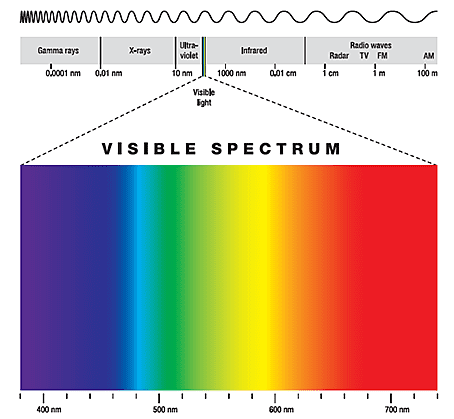
Source: “Preventblindness.org” accessed 28.11.22
The benefits of blue light are that:
- During the daytime, it boosts alertness, helps memory and cognitive function and elevates mood.
- It regulates circadian rhythm – the body’s natural wake and sleep cycle. Exposure to blue light during daytime hours helps maintain a healthful circadian rhythm. Too much exposure to blue light late at night (through smart phones, tablets, and computers) can disturb the wake and sleep cycle, leading to problems sleeping and daytime tiredness.
- Not enough exposure to sunlight in children could affect the growth and development of the eyes and vision. Early studies show a deficiency in blue light exposure could contribute to the recent increase in myopia/near-sightedness.
However, Blue light has a sinister side too.
Almost all visible blue light passes through the cornea and lens and reaches the retina. The widespread use of electronics and energy efficient lighting at night becomes disruptive at night as increase to blue wave lengths increase. This light may affect vision and could prematurely age the eyes.
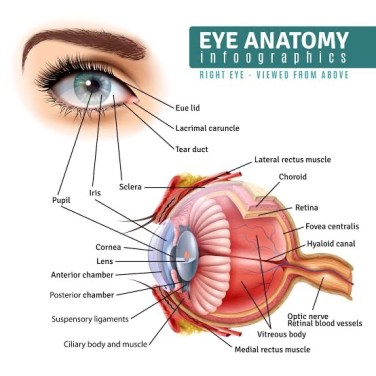
https://www.pacificvisionarticles.com/what-are-the-eyes-made-of/
Research has revealed that too much exposure to blue light can lead to the following:
Digital eyestrain – Blue light from computer screens and digital devices can decrease causing digital eye strain. Fatigue, dry eyes, bad lighting, or how you sit in front of the computer can cause eyestrain. Eyestrain leads to sore or irritated eyes and difficulty focusing.
Retina damage – Research results suggest that continued exposure to blue light over time could lead to damaged retinal cells which in turn can lead to macular degeneration.
Source: ‘Preventblindness.org’, accessed 28.11.22
In fact, in an article titled ‘Blue Light has a dark side’, published by Harvard Health Publishing of the Harvard Medical School on 7 July 2020, it was stated that in addition to the circadian rhythm being thrown out of whack blue light could contribute to the causation of cancer, diabetes, heart disease, and obesity.
The same article went on to give further details of a Harvard study which linked too much exposure to blue light to diabetes and possibly to obesity. It stated that when:
“Researchers put 10 people on a schedule that gradually shifted the timing of their circadian rhythms. Their blood sugar levels increased, throwing them into a prediabetic state, and levels of leptin, a hormone that leaves people feeling full after a meal, went down.
Exposure to light suppresses the secretion of melatonin, a hormone that influences circadian rhythms. Even dim light can interfere with a person’s circadian rhythm and melatonin secretion. A mere eight lux—a level of brightness exceeded by most table lamps and about twice that of a night light—has an effect, notes Stephen Lockley, a Harvard sleep researcher. Light at night is part of the reason so many people don’t get enough to sleep, says Lockley, and researchers have linked short sleep to increased risk for depression, as well as diabetes and cardiovascular problems.”

Is there anything we can do to arrest the damage that blue light waves is causing our eye health and for that matter our general health? The answer is YES! Phew!
We can:
1) Try to decrease the amount of time spent in front of screens and/or take frequent breaks to give your eyes a rest.
2) Use screen filters that are available for smart phones, tablets, and computer screens. They decrease the amount of blue light given off from these devices that could reach the retina in our eyes.
3) Use computer glasses with yellow-tinted lenses that block blue light which can help ease computer digital eye strain by increasing contrast. If you work a night shift or use a lot of electronic devices at night, consider wearing blue-blocking glasses or installing an app that filters the blue/green wavelength at night.
4) Use anti-reflective lenses to reduce glare and increase contrast and also block blue light from the sun and digital devices.
5) If having cataract surgery, after surgery, the cloudy lens can be replaced with an intraocular lens (IOL). The lens naturally protects the eye from almost all ultraviolet light and some blue light. There are types of IOL that can protect the eye and retina from blue light.
6) Use dim red lights for night lights. Red light is less likely to shift circadian rhythm and suppress melatonin.
7) Expose yourself to lots of bright light during the day, which will boost your ability to sleep at night, as well as your mood and alertness during daylight
Websites & Articles referenced:
‘Preventblindness.org’, accessed 28.11.22
‘Blue Light has a dark side’, Harvard Health Publishing, Harvard Medical School, 7 July 2020.



 April’s Musingz
Leave a comment